LottoGo Licence, Safety and UK Player Rules
 Available in GB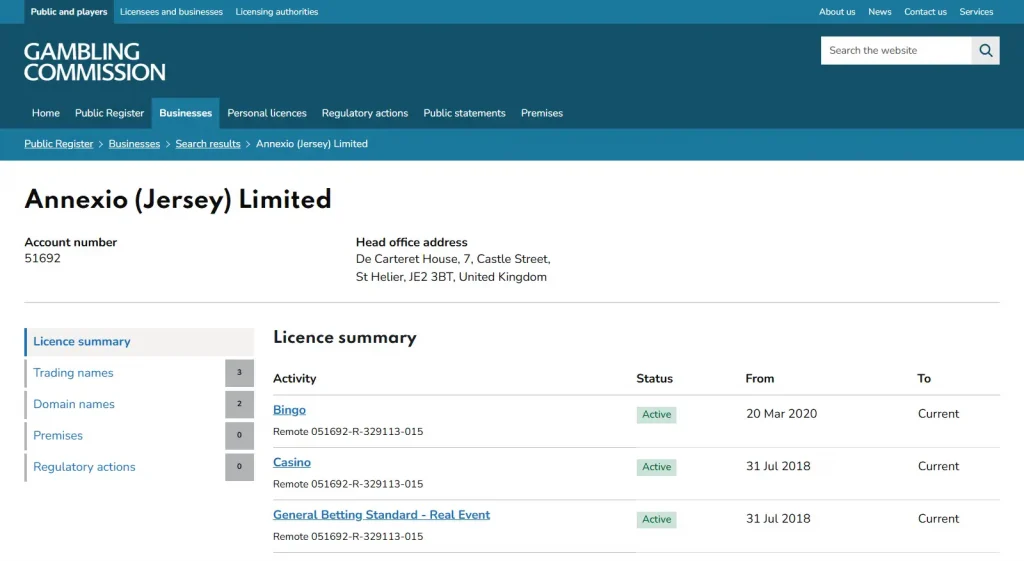
For Great Britain players, LottoGo has a directly verifiable UK Gambling Commission record. The Commission’s public register lists Annexio (Jersey) Limited under account 51692, shows www.lottogo.com as an Active domain and shows remote casino licence reference 051692-R-329113-015 as Active. Those are stronger facts than a review site’s general statement that a casino is “licensed” or “safe”.
The register does not guarantee that every game, bonus or customer interaction will be perfect. What it establishes is the licensed operator and the regulatory permissions connected to the domain. The practical UK rules then add concrete protections and constraints: age and identity verification, online-slot stake caps, a 10x ceiling on bonus wagering requirements, restrictions on mixed-product incentives, GAMSTOP, financial vulnerability checks and changing deposit-limit standards. Keep those verifiable rules separate from broader subjective trust claims.
Table of Contents
- The UKGC record for LottoGo
- Operator, domain and remote-casino permissions
- What UKGC licensing means – and what it does not guarantee
- Online-slot stake caps and bonus rules
- GAMSTOP, vulnerability checks and advertising protections
- Deposit-limit rules from 30 September 2026
- What the UKGC record and current UK rules mean for LottoGo players
The UKGC record for LottoGo
The most useful licence check starts with the regulator rather than with the casino footer. Search the UK Gambling Commission public register for LottoGo, lottogo.com or account number 51692. The current register result identifies Annexio (Jersey) Limited and lists lottogo.com as an active trading name. The domain page separately lists www.lottogo.com with status Active.
The licence summary for account 51692 currently shows Casino Remote reference 051692-R-329113-015 as Active, alongside active Bingo Remote and General Betting Standard – Real Event Remote activities under the same reference. For a UK player, the important line is the active remote casino activity. That is the register evidence connecting the operator to permission for remote casino gambling.
This matters because brand names and corporate names are not always identical. A player may encounter LottoGo on the website while the regulatory record is under Annexio (Jersey) Limited. The correct verification process is therefore not to stop because the brand name is different from the legal operator name. Match the account, trading name and domain in the register and then inspect the licence activity and status.
The public register can be checked directly on the UK Gambling Commission licence summary and its domain-name page. For wider product context, see the LottoGo casino review; the regulatory record and UK player rules are the key checks here.
Operator, domain and remote-casino permissions
The UKGC-listed operator for www.lottogo.com is Annexio (Jersey) Limited. Official LottoGo sources also identify a Jersey Gambling Commission licence, RG0-005-18, for Annexio (Jersey) Limited. For a player in Great Britain, however, the UKGC entry is the central check because remote gambling offered to consumers in Great Britain requires the relevant Gambling Commission licence.
A remote casino licence is not simply a badge attached to a homepage. It brings the activity within the Commission’s licensing framework and codes. The current UKGC entry shows the remote casino permission as Active. The domain listing also matters because it helps distinguish the regulated website from a lookalike address. When checking a gambling site, compare the exact domain you are using with the domain shown by the regulator rather than relying on a logo or search-ad headline.
The statutory licensing objectives include keeping gambling fair and open, preventing gambling from being associated with crime or disorder, and protecting children and other vulnerable people from harm or exploitation. These objectives shape rules that apply to licensees, but they should not be turned into a blanket promise that a particular session, game outcome or customer-service interaction will be satisfactory.
That distinction is useful when evaluating claims such as “LottoGo is legit” or “LottoGo is safe”. The factual position is that the UKGC register shows an active domain and active remote casino permission under a named operator. A stronger subjective judgement would require different evidence and can blur the difference between regulatory status, product quality and an individual’s gambling risk.
The register is also a useful defence against outdated or copied licence claims. A review can remain online long after an operator, domain or permission changes. The live regulator record should be the final check when licence status is material to your decision. Save or note the account number so you can return to the correct entry directly.
What UKGC licensing means – and what it does not guarantee
UKGC licensing means LottoGo’s Great Britain-facing remote gambling activity sits within enforceable licence conditions, technical standards and social responsibility rules. Those rules cover areas such as identity verification, fair and open gambling, customer interaction, self-exclusion, financial vulnerability checks and promotional practices. Breaches can lead to regulatory action against a licensee.
It does not mean the regulator guarantees winnings, approves every promotion in advance or promises that a withdrawal will arrive within a fixed number of hours. Nor does an active licence make gambling financially safe. Casino games remain products in which outcomes can result in losses, and a regulated operator can still be the subject of complaints or compliance action. The LottoGo withdrawal guide keeps payout checks separate from licence status for the same reason.
For practical checking, separate three questions. First: is the operator and domain present in the current register? For LottoGo, yes – Annexio (Jersey) Limited, account 51692, with www.lottogo.com Active. Second: is the relevant remote casino activity Active? The current summary says yes. Third: are the particular terms you care about current? Bonus details, cashier options and account controls can change, so the live terms and account interface remain important even when the licence record itself is clear.
The same logic applies across the site. The LottoGo games guide describes the main product categories, while the LottoGo Lottery Betting and Casino: How the Hybrid Model Works explains the hybrid model. Neither product variety nor a licence entry should be used as a shortcut for deciding how much to gamble.
Online-slot stake caps and bonus rules
Great Britain now has statutory maximum stakes for online slots. The maximum per game cycle is £5 for customers aged 25 and over and £2 for customers aged 18 to 24. These caps apply to online slots, not to other casino games such as roulette or blackjack. The LottoGo live casino guide is therefore separate from the slots rules rather than treating every casino table as if it shared the same stake cap.
For bonuses, UKGC Social Responsibility Code 5.1.1 now caps promotional wagering requirements on bonus funds at a maximum of 10 times. The same rules prohibit a single incentive from including more than one gambling product category, such as combining casino and betting play in one incentive. These changes came into force on 19 January 2026 and are directly relevant when assessing a current promotion.
The practical implication is that a UK player should read a bonus in terms of qualifying deposit, bonus funds, wagering requirement, eligible product category, time window and any maximum-bet rule stated in the offer. The regulatory 10x cap is a ceiling, not a promise that every offer uses exactly 10x. LottoGo’s LottoGo Bonus & Promotions handles the current offer details separately so this regulatory page does not turn one promotion into a permanent site rule.
Slot stake caps and bonus restrictions solve different problems. One limits the amount staked in an online-slot game cycle according to age; the other constrains promotional design. Seeing both together helps explain why a licensed UK casino experience can differ materially from an offshore site even when the underlying games look similar on screen.
These rules also show why a compliance page should not collapse everything into a single “safe or unsafe” label. Stake caps can reduce maximum exposure per slot cycle, while bonus rules reduce promotional complexity, but neither removes the possibility of loss. A useful player check is therefore rule-specific: identify which protection applies to the activity you are actually considering and avoid assuming that one safeguard covers unrelated products or decisions.
GAMSTOP, vulnerability checks and advertising protections
GAMSTOP Online provides multi-operator self-exclusion across gambling websites and apps run by businesses licensed in Great Britain. A user can make one request and be prevented from using those licensed online services for the chosen exclusion period. This is broader than closing or limiting one LottoGo account and is relevant when someone wants a system-wide barrier rather than a single-site setting.
Remote gambling businesses are also subject to light-touch financial vulnerability checks. The Gambling Commission says these checks became a requirement in August 2024 and use publicly available information to identify indicators such as bankruptcy orders or a history of unpaid debts. The current code requires checks for customers who meet the relevant threshold. These checks are distinct from the separate financial risk assessment work the Commission has piloted.
Advertising has its own protection framework. The CAP Code requires gambling marketing to be socially responsible and gives particular attention to protecting children, young people and vulnerable people from harm or exploitation. Gambling ads must not be directed at under-18s through media or context, and content likely to have strong appeal to under-18s is restricted. These rules affect how gambling can be promoted; they are not evidence that an individual promotion is automatically good value.
For the player, the useful connection is that licensing is not just a register entry. It links to systems around exclusion, customer interaction and marketing. If gambling is becoming difficult to control, the existence of these tools matters more than whether a particular game or bonus looks attractive. Account-level controls can help, while GAMSTOP provides a wider self-exclusion mechanism.
These protections are most useful when understood before they are needed. GAMSTOP is designed for self-exclusion, vulnerability checks are operator-side controls triggered under regulatory rules, and advertising standards govern how gambling is promoted. They are different tools with different purposes. A player deciding whether to keep gambling should not treat the existence of an operator check or a compliant advert as a substitute for their own budget, time limits or decision to stop.
Deposit-limit rules from 30 September 2026
The revised UKGC RTS 12B requirements are scheduled to take effect on 30 September 2026. Until that date the revised provisions are not yet in force; from the effective date, deposit-limit controls should be assessed against the implemented UKGC requirements.
From 30 September, covered gambling systems must offer gross deposit limits as a minimum. A gross deposit limit measures the amount a customer deposits into the account over the relevant duration without netting off withdrawals. Under the revised rule, only a limit meeting that definition may be called a “deposit limit”, and gross deposit limits must be offered with at least equal prominence to other types of financial limit.
The revised RTS also requires available periods to include 24 hours, seven days and one month. If a customer sets simultaneous time frames, the most restrictive limit must apply. Once a deposit limit is reached, the system must prevent further deposits until the defined period restarts or the customer takes action to increase the limit, subject to the standard cooling-off requirement.
This gives a concrete account check for LottoGo players after the implementation date: look at the limit interface and distinguish a gross deposit limit from a net deposit, loss or stake limit. Before that date, do not assume the new labels and presentation are already mandatory. For account setup and KYC context, see the LottoGo registration guide.
What the UKGC record and current UK rules mean for LottoGo players
The strongest trust check for LottoGo in Great Britain is specific and reproducible: the UK Gambling Commission register lists Annexio (Jersey) Limited under account 51692, www.lottogo.com is Active, and remote casino licence reference 051692-R-329113-015 is Active. A player can verify those entries directly rather than relying on a generic licence logo.
After that, judge the service through the rules that affect real decisions. Identity must be verified before gambling; online-slot stakes are capped by age group; bonus wagering requirements cannot exceed 10x and incentives cannot mix gambling product categories; GAMSTOP supports online multi-operator self-exclusion; remote operators face financial vulnerability-check duties; and gambling advertising is subject to social-responsibility protections.
Finally, keep the calendar in view. On 30 September 2026 the revised deposit-limit framework is due to take effect, changing the required definition and presentation of gross deposit limits. Regulatory status can be checked at a point in time, but player-facing terms and interfaces still deserve a current check before you deposit, claim a promotion or make an important account decision.
When checking the register, use the operator name, account number and exact domain together. That combination helps distinguish the LottoGo service from a lookalike address and makes it easier to return to the same regulator entry later. If the status or domain record changes, use the live UKGC entry rather than an older licence badge or copied description.
The register is most useful when you use it as an identity check rather than as a badge. Start with Annexio (Jersey) Limited, match account 51692, then confirm that www.lottogo.com appears as an active domain and that the relevant remote permissions remain active. This three-part check reduces the risk of relying on a copied logo or a similarly named website. It also gives you a repeatable way to check the service later: return to the same UKGC business record and compare the operator, domain and activity status rather than searching for a new marketing claim.
The player rules answer a different set of questions. The age-based £2 and £5 online-slot stake caps limit the maximum stake per slot game cycle; the 10x bonus-wagering ceiling limits promotional wagering requirements; GAMSTOP provides a multi-operator online self-exclusion route; and vulnerability-check and advertising rules add further consumer-protection obligations for operators. None of those provisions predicts whether an individual gambling session will end in a win or whether every service interaction will be satisfactory. Their value is that they set boundaries and responsibilities that can be checked separately from LottoGo’s promotions and game catalogue.
The deposit-limit change due on 30 September 2026 should be treated with the same precision. It concerns how remote operators must define and present gross deposit limits, so it is an account-control issue rather than a statement about bonus value or game stakes. Until the change takes effect, keep the future date distinct from rules already in force. After that date, the current LottoGo account interface and the live UKGC requirements should be checked together. This separation between operator identity, current player rules and dated regulatory changes makes the licence page more useful than a single broad claim that a gambling site is simply “safe” or “legal”.
That structure also makes future checks simple: verify the operator first, then the rule that applies to the decision you are making, and only then look at the commercial offer.